
Spirulina & Chlorella 101: The Ancient Algae Behind Modern Wellness
Affiliate disclosure: This post contains an affiliate link. If you purchase through it, I may earn a small commission at no extra cost to you.

If you've spent any time in the wellness world, you've seen the words "spirulina" and "chlorella" tossed around interchangeably — usually next to a green smoothie and a promise that it will change your life. As a practitioner who bridges Western clinical nutrition with Traditional Chinese Medicine (TCM), I want to slow down and actually explain what these two organisms are, because the "superfood" label — while earned — often skips the fascinating biology underneath it.
What Spirulina and Chlorella Actually Are
Both spirulina and chlorella are microalgae — single-celled or filamentous organisms that photosynthesize, meaning they generate energy from sunlight the same way plants do. But they are not plants, and they're not the same species as each other.
Spirulina (genus Arthrospira) is a blue-green algae, technically classified as a cyanobacterium. It grows naturally in warm, alkaline lakes in regions including East Africa, Mexico, and parts of Asia.
Chlorella is a true green algae (a single-celled eukaryote), most commonly grown in freshwater. Unlike spirulina, chlorella has a tough outer cell wall — a detail that matters, because it's the reason quality chlorella supplements are processed to "crack" that wall for digestibility.
Both organisms are among the oldest life forms on Earth. Cyanobacteria similar to spirulina are believed to have existed for roughly 3.5 billion years, and are credited by many evolutionary biologists as being among the first organisms to produce oxygen through photosynthesis — quite literally helping shape the atmosphere we breathe today.
Not a New Trend — A Rediscovered One
While spirulina and chlorella feel like recent wellness-world arrivals, their use as food predates modern supplement culture by centuries. Historical records document the Aztecs harvesting spirulina from Lake Texcoco in the 16th century, and the Kanembu people of Chad have traditionally harvested spirulina from Lake Chad for generations, forming it into dried cakes called dihé that are still consumed today.
Chlorella's more recent claim to relevance came in the mid-20th century, when researchers — particularly in Japan — began investigating it as a potential large-scale food source due to its rapid growth rate and dense nutrient profile. Japan remains one of the largest producers and consumers of chlorella globally today.
This matters because it reframes the conversation. These aren't synthetic lab creations engineered for a supplement aisle — they're some of the most nutrient-dense, longest-standing food sources available to us, only recently re-entering mainstream nutrition science.
Why They Get Bundled Together
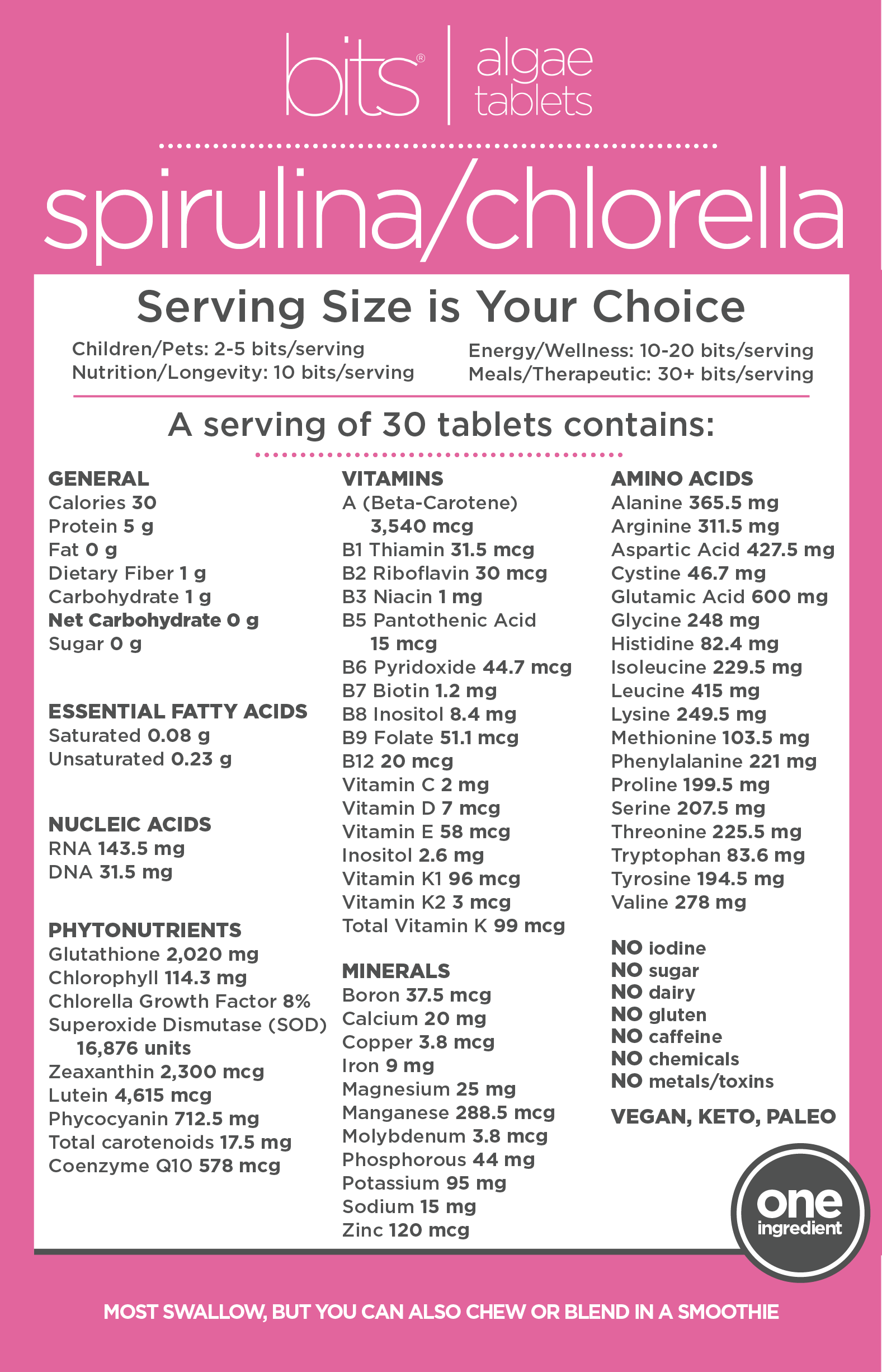
Spirulina and chlorella are often sold side by side — including in products like Energy Bits — because they're nutritionally complementary rather than redundant. Broadly speaking:
Spirulina tends to be higher in protein and phycocyanin (its signature antioxidant pigment, which we'll cover in week 7).
Chlorella tends to be higher in chlorophyll and certain binding compounds related to its cell wall structure (more on that in week 17).
Used together, they cover a broader nutritional range than either does alone — which is part of why so many algae tablets combine both rather than isolating one.
The TCM Lens: Why Density Matters
In Traditional Chinese Medicine food therapy, foods are evaluated not just by nutrient content but by how efficiently the body can transform them into usable Qi — the energy that fuels every physiological process. Foods that are nutrient-dense and easily assimilated are prized precisely because they deliver more benefit for less digestive effort.
Microalgae fit this description almost uniquely well. Because spirulina and chlorella are single-celled organisms without the tough fibrous structure of most land plants, the nutrients they contain are generally considered more readily accessible to the body — a modern echo of an old TCM principle: quality and digestibility matter as much as raw nutrient content.
By the Numbers
A few figures worth sitting with:
Spirulina is composed of roughly 55–70% protein by dry weight — among the highest protein concentrations of any whole food source, plant or animal (comparatively, lean beef is around 26% protein by weight).
Chlorella contains more chlorophyll per gram than nearly any other food source studied, which is part of why it's often described as having a more concentrated "green" nutrient profile than typical leafy vegetables.
Global spirulina production has grown substantially over the past two decades as commercial cultivation has scaled, according to industry and agricultural research bodies tracking algae as an emerging food category.
(Exact production figures vary by year and source — if you want current market data for a specific claim, that's worth a quick verification pass before publishing, since supply-chain stats shift year to year.)
Where This Series Is Headed
Over the next 24 weeks, we're going to go organism by organism, nutrient by nutrient, through everything spirulina and chlorella actually do — the protein science, the iron and B-vitamin conversation (including where the marketing oversells it), the antioxidant research, the sourcing and safety questions, and how I personally build these into a daily ritual with Energy Bits.
This isn't going to be a highlight reel of miracle claims. It's going to be the same standard I hold every product to in my own practice: does the research actually support what's being said, and does it hold up next to a framework — TCM — that's been evaluating food-as-medicine for thousands of years.
This post is for educational purposes and reflects general research on spirulina and chlorella. It is not a substitute for individualized medical advice. If you have a specific health condition, are pregnant or nursing, or are on medication, please consult your physician or a qualified healthcare provider before adding any new supplement to your routine.
